
α — PENAVIS
Legal Technology · Enterprise · Government · Malaysia · Launching August 2026
Penavis produces the verbatim record that legal proceedings depend on. We pair automated speech recognition with trained human editors working in purpose-built tools, so the output carries the accuracy a court requires and arrives at the pace a docket demands.
Legal transcription intelligence platform — hybrid AI/human production for law firms and government
The problem in the vertical
Courts and legal practices run on the written record. Judgments cite it, appeals turn on it, and the parties are bound by what it says. The record has to be verbatim and it has to be attributable, because a single transposed word can change what a witness is taken to have said. This is not a domain where an approximate transcript is useful. It is either the record or it is nothing.
Transcription of legal proceedings is also chronically backlogged. Skilled stenographers and transcriptionists are scarce, proceedings run long, and demand does not fall. Firms wait weeks for records they need in days. The pressure to clear the queue is real, which is exactly why the temptation to accept raw machine output is dangerous. Automated speech recognition is fast and improving, but it misattributes speakers, collapses on crosstalk, and invents plausible words where the audio is unclear. In a record that carries evidentiary weight, a confident error is worse than an obvious gap.
Malaysian proceedings add a further constraint. Courtrooms here move between Bahasa Malaysia and English, often within a single exchange, alongside legal terminology, proper nouns, and the names of parties and places that no general model has been trained on. A transcription system built for a single language and a single accent does not survive contact with this reality. The vertical demands a system engineered for how the record is actually produced, not a general tool pointed at a hard problem.
The system
Penavis is a production pipeline, not a model. Audio enters automated speech recognition to produce a first draft, and that draft is then worked by trained human editors until it reaches court-grade accuracy. The machine handles volume and the humans hold the standard. Neither step is optional, and the discipline of the handoff between them is where the quality lives.
The editors work in tools we built for this task. VTTE and TRE are purpose-built transcript editors that keep the audio, the draft, and the correction in one controlled surface, so an editor can verify against the source rather than retype from it. The tools enforce speaker attribution, preserve timing, and make the verbatim standard something the workflow protects rather than something an editor has to remember. Building the editors ourselves means the workflow and the interface were designed together, for the way legal transcription is actually done.
The result is a record produced at production speed without surrendering the accuracy the setting requires. Penavis is deployed for law firms and government users in Malaysia, handling bilingual proceedings as a normal condition rather than an edge case. Data is handled under controls aligned to ISO 27001, with certification in progress, because a system that holds legal records has to be trusted with them as much as it is trusted to produce them.
Penavis is built and operated within Alnaire's vertical AI foundry. Its hybrid AI and human production line draws on the applied AI systems Alnaire engineers for regulated work.
PLATES
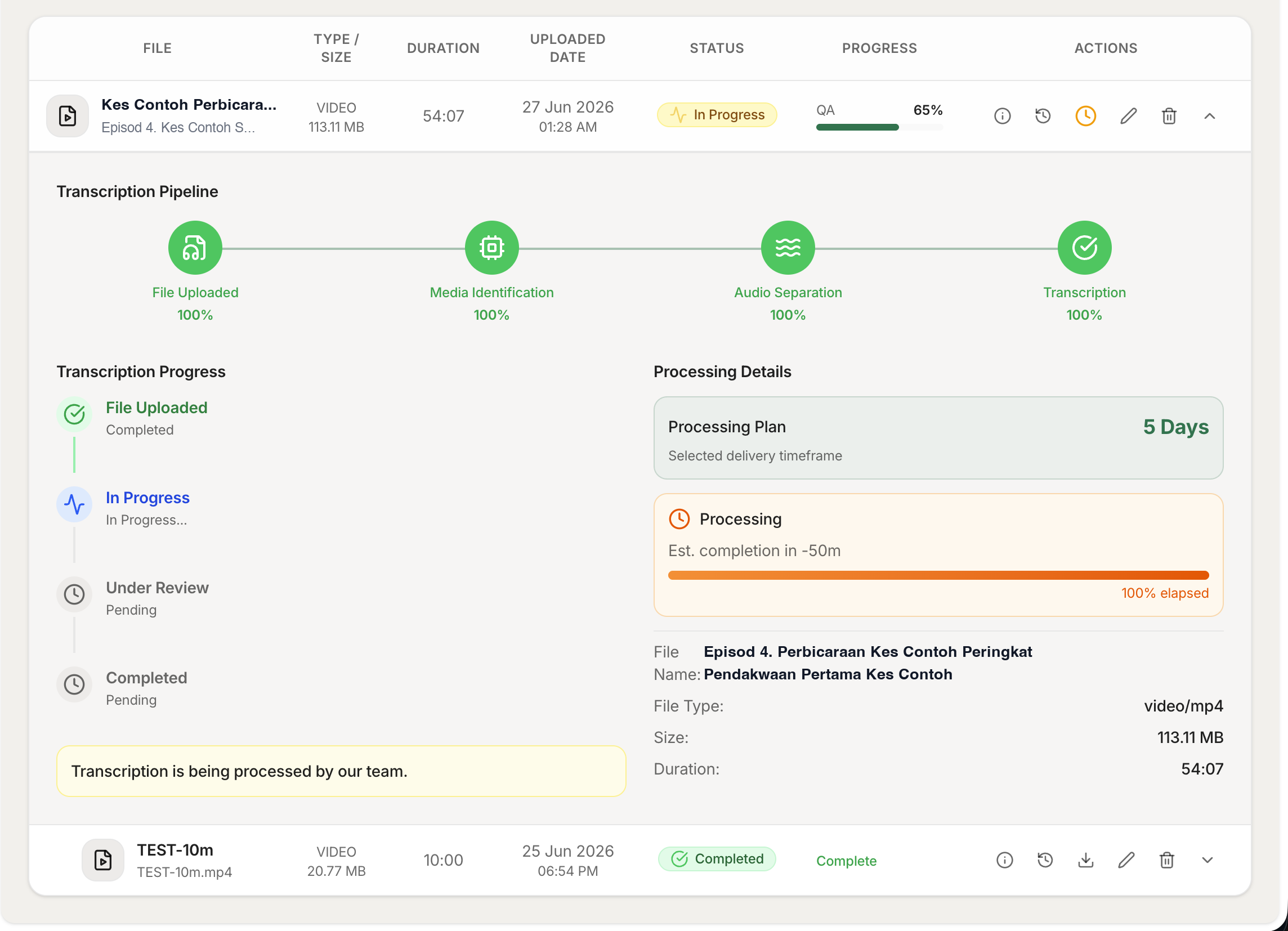
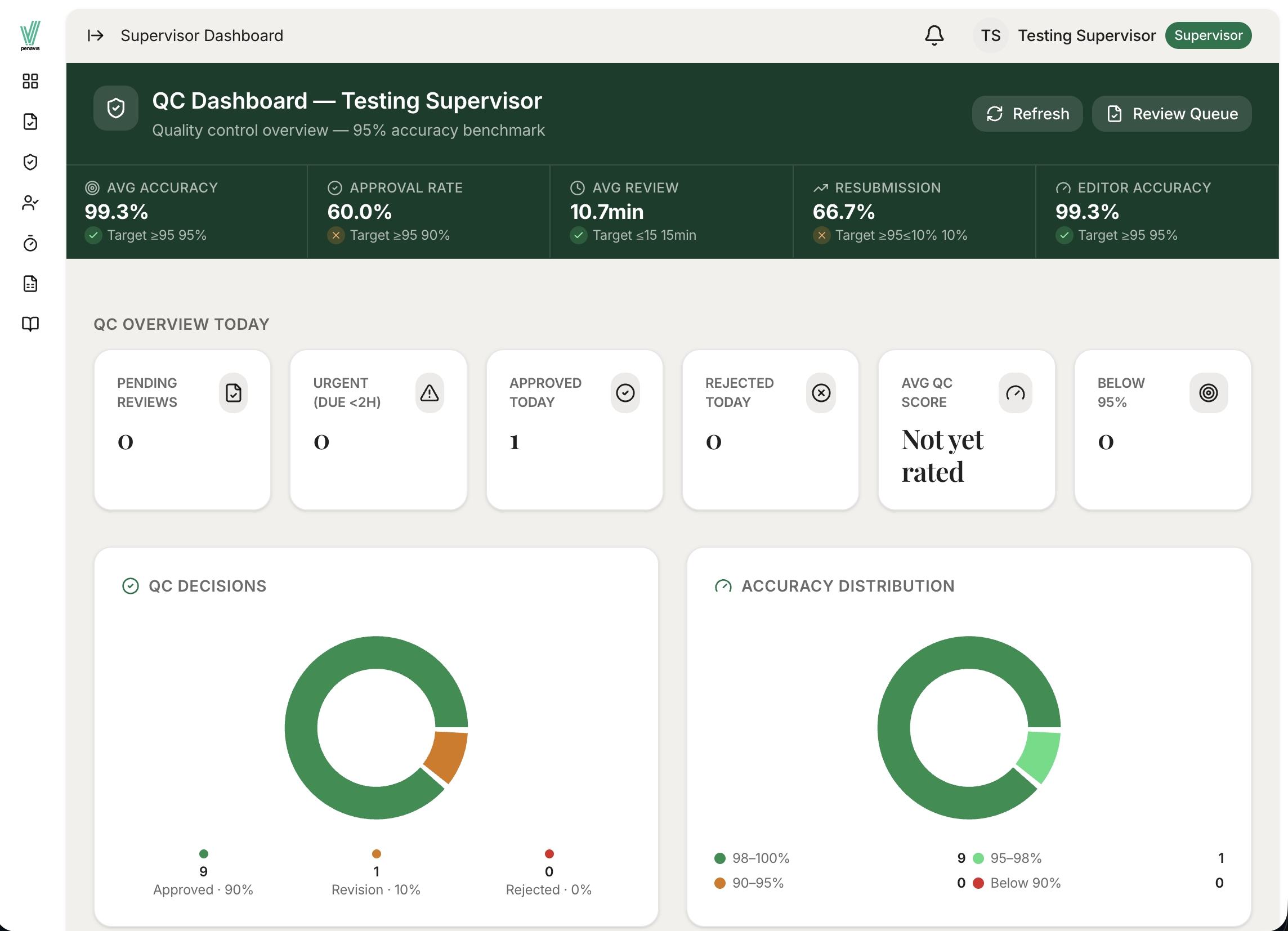
Captures show demonstration data. Client-identifying content is removed before publication.
OPERATING FACTS
- Hybrid AI/human production pipeline in daily operation
- Deployed for law firms and government users in Malaysia
- Proprietary VTTE and TRE transcript editors built in-house
- Bilingual Bahasa Malaysia and English proceedings supported
- Data handled under ISO 27001-aligned controls, certification in progress
VISIT